Featured Story
Product
Blueprint: A Specification Layer for Adaptive Data


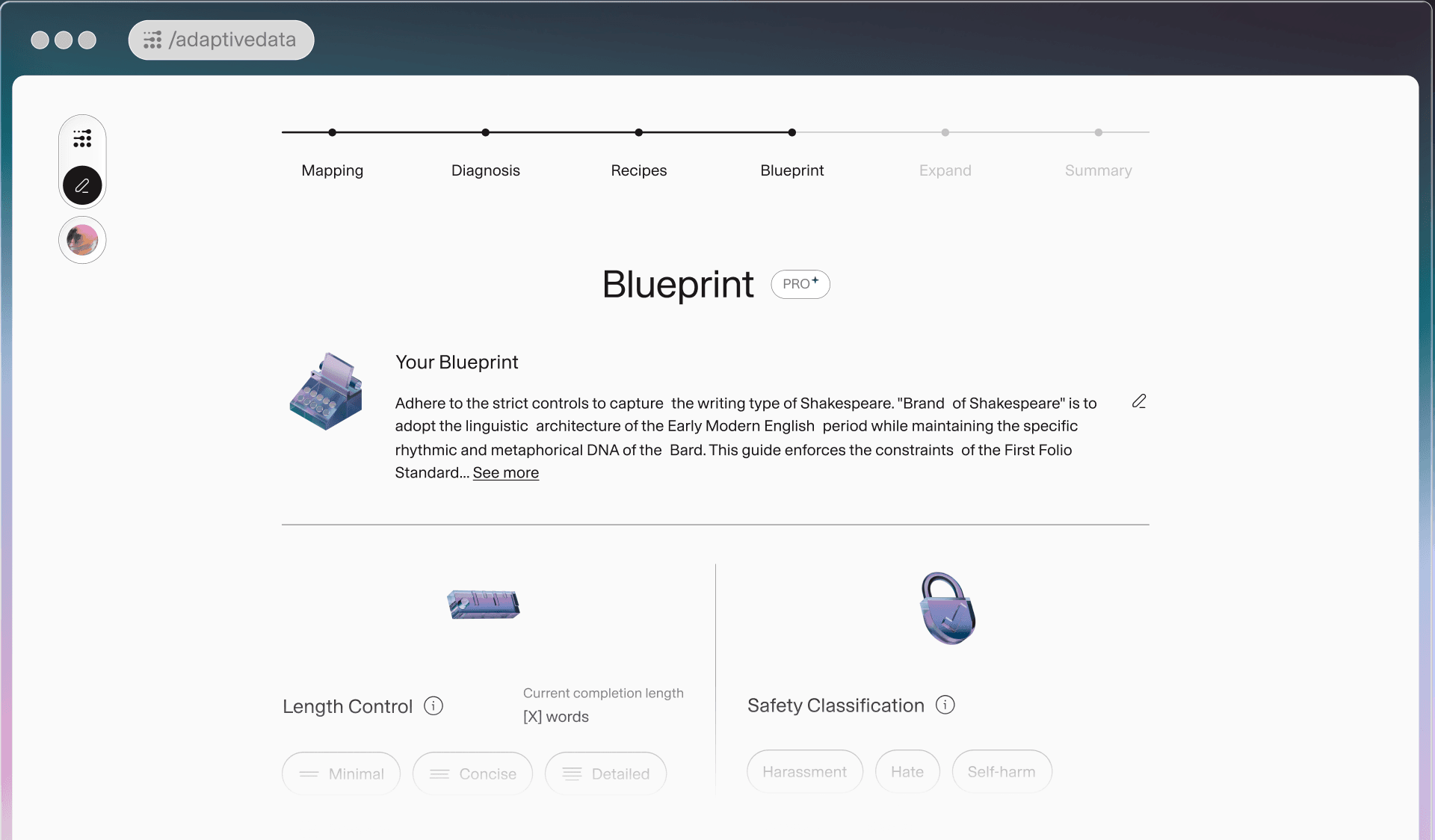
Two weeks ago we announced Adaptive Data, a platform to allow everyday builders to control and adapt their data. Adaptive Data is a fundamental shift: we treat the data space as dynamic and fully malleable. Today we are adding a new powerful capability to Adaptive Data for builders everywhere to shape AI. We call our release Blueprint.
Blueprint allows you to steer the data space towards any goal you want. Think of it as the preferences sheet you give to a concierge service before you trust AI to come back with a tailored itinerary. Blueprint efficiently steers data towards your specific desirable properties, and automatically learns penalties if AI violates any of your rules.
The field has made extraordinary progress on what models can do. The harder, quieter question — how to make AI behavior durable, transferable, and precisely defined — has received far less attention. We think that's the next important frontier. Blueprint is our first move toward it.
Why Specification Is an Unsolved Problem
Telling an AI system what to do is easy. Ensuring it reliably does that, and only that, across contexts, inputs, and time is not.
The dominant approach is prompt engineering: iterative, informal, and local. It works until it doesn't. Requirements accumulate as workarounds. Constraints that held in one context quietly fail in another. There is no principled mechanism for encoding what good behavior looks like in a way that is explicit, auditable, and persistent.
This is a specification problem. And unlike capability, it doesn't get easier as models get more powerful. If anything, the gap between what a system can do and what it should do in any given context widens.
A New Layer in Adaptive Data
We built Blueprint because we firmly believe data that evolves with the world is only useful if it evolves the right way. With this release, we’re bringing innovations in data optimization typically reserved for frontier labs to everyone.
Blueprint lets you define your goals — length, tone, safety thresholds, custom content policies — and have those automatically changed to objectives which optimize every dataset the platform produces. When your requirements change, your data automatically evolves with them.
The design principle is simple but consequential: data configuration should be foundational, not cosmetic. Your requirements become the specification every data point is evaluated against. Not a preference layered on top. A structural constraint built in from the start.
We think this reframing matters. Treating data behavior as a first-class property — something you define, version, and enforce — is a different posture toward data systems than the field has generally taken.
The Way Forward
The field has made remarkable progress on what AI systems can do. The next frontier is making them controllable — not just capable. That requires innovation at every layer: in how data is shaped and specified, in how intelligence generalizes across contexts, and in how humans interact with systems that are no longer static.
Blueprint is one piece of that. But our underlying conviction is larger genuine control over AI behavior is both an unsolved research problem and one of the most important ones to work on.
At Adaption, we started this journey because we believe today’s AI is backwards. Most systems are static, expensive, and slow to change. Exceptional use cases, the ones that matter most in real world contexts are treated like outliers. We are setting out to change that. Intelligence should not arrive preconfigured. AI should evolve and learn continuously. That starts with data.
Everything intelligent adapts. So should AI.
Blueprint is available to all Adaptive Data users around the world today. Our commitment is to empower everyday individuals, developers and enterprises to shape and control their AI. Our research grant program provides access to the platform for teams exploring adaptive data systems, behavioral specification, and AI control.
Date